
Hey there, busy bee! Ever feel like your to-do list is a never-ending monster that’s eating your time and sanity? You’re not alone. In our jam-packed world, knowing how to prioritize tasks effectively is like having a superpower. It helps you slash stress, boost productivity, and actually get stuff done without burning out. This guide breaks it down into simple, actionable steps so you can accomplish more—without the overwhelm. Let’s dive in and turn chaos into calm!
Why Prioritizing Tasks Changes Everything
Picture this: You’re juggling emails, meetings, that big project, and oh yeah, grabbing coffee before you crash. Sound familiar? Without smart prioritization, important tasks get buried under the urgent fluff. Prioritizing isn’t about doing more—it’s about doing what matters most, first.
Studies from productivity gurus like David Allen (of Getting Things Done fame) show that people who prioritize well finish 20-30% more high-impact work daily. Why? Because it frees your brain from decision fatigue. You stop wasting energy on “what next?” and start crushing goals.
The magic happens when you align tasks with your big-picture wins. Want to hit that promotion, launch your side hustle, or just enjoy more family time? Effective task prioritization puts you in the driver’s seat. Ready to learn how? Let’s get to the good stuff.
Step 1: Master the Eisenhower Matrix for Quick Wins
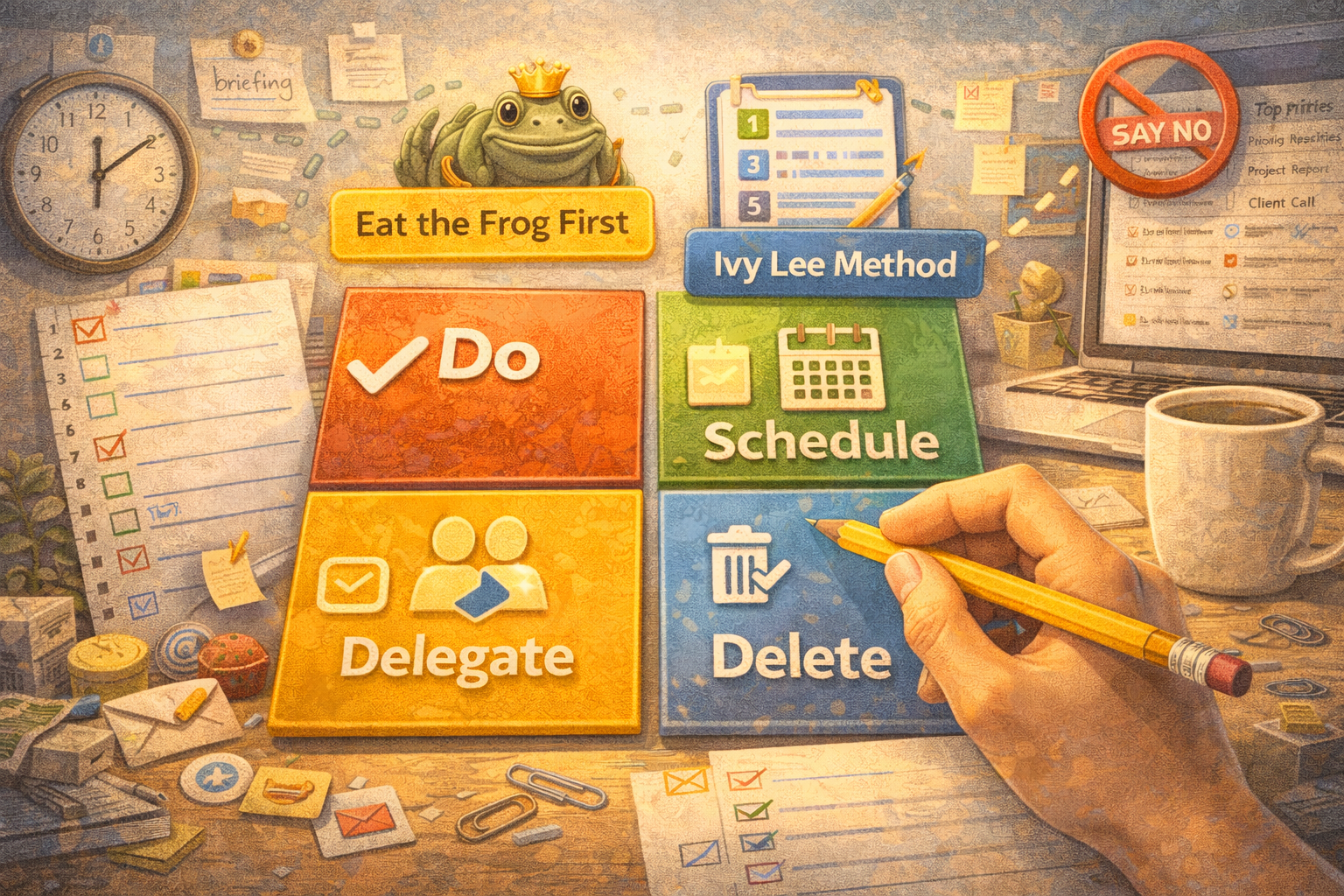
First up, grab a tool that’s been saving backsides since the 1950s—the Eisenhower Matrix. Named after President Dwight D. Eisenhower (who said, “What is important is seldom urgent and what is urgent is seldom important”), this bad boy sorts your tasks into four quadrants. It’s dead simple and game-changing.
Here’s how it works:
- Urgent and Important (Do It Now!): Crises, deadlines, or anything that moves the needle on your goals. Example: Fixing a client emergency or prepping for a key presentation. Tackle these first—no excuses.
- Important but Not Urgent (Schedule It): Long-term gold like exercise, skill-building, or planning your next project. These build your future success. Block time in your calendar for them.
- Urgent but Not Important (Delegate It): Think endless emails or minor admin. Pass them off to a teammate, app, or virtual assistant if possible.
- Neither Urgent nor Important (Delete It): Social media scrolls, pointless meetings? Ditch ’em. They’re time thieves.
Quick Tip: Draw a 2×2 grid on paper or use free apps like Todoist or Trello. Dump all your tasks in, then sort. In 10 minutes, your day gets crystal clear. I once had a client who reclaimed two hours daily just by nuking quadrant four tasks. Boom—instant accomplishment boost!
Pro move: Review your matrix every morning. Life changes, so should your priorities.
Step 2: Eat the Frog and Use the Ivy Lee Method
Now that you’ve sorted, it’s time to attack. Mark Twain nailed it: “Eat a live frog first thing in the morning and nothing worse will happen to you the rest of the day.” In productivity speak? Do your hardest, most dreaded task first.
Why? Your willpower peaks in the morning (science backs this—cortisol and focus are high pre-noon). Knock out the frog, and the rest feels like a breeze. Accomplish more? You bet—momentum kicks in like rocket fuel.
Pair it with the Ivy Lee Method, a 100-year-old hack from a productivity whiz:
- At day’s end, list your top 6 tasks for tomorrow (no more—keep it focused).
- Rank them by true impact, not urgency.
- Work solely on #1 until done.
- Move to #2, and so on.
- Repeat daily, scrubbing unfinished tasks to the next day’s list.
This method forces ruthless prioritization. No multitasking nonsense—just laser focus. One study from the University of California found single-taskers outperform multitaskers by 40%. Try it for a week; you’ll wonder how you survived without it.
Light-hearted hack: Name your frogs! “Math Homework Monster” or “Email Avalanche.” Laughing at them shrinks their power.
Step 3: Say No Like a Pro and Set Boundaries
Here’s a tough truth: You can’t do it all. Prioritizing means saying no to good things so great things can happen. Warren Buffett sums it up: “The difference between successful people and really successful people is that really successful people say no to almost everything.”
Audit your yeses. Does this task align with your top 3 goals? If not, politely decline. Script it: “Thanks for thinking of me, but I’m focusing on [priority] right now.”
Set boundaries too:
- Time block your calendar: Use Google Calendar to chunk your day—deep work 9-11 AM, emails 4-5 PM.
- Batch similar tasks: Answer all messages at once, not ping-pong style.
- Weekly review: Sunday evenings, scan wins, flops, and adjust.
Tools like RescueTime track where your time vanishes (spoiler: often cat videos). Apps such as Focus@Will or Forest gamify focus with music and tree-growing rewards. Fun, right?
Real talk: Boundaries prevent burnout. One entrepreneur I coached added “no-meeting Wednesdays” and doubled output. Accomplish more by doing less—counterintuitive but true.
Tackle Procrastination and Build Momentum
Even with priorities set, procrastination sneaks in. Beat it by breaking tasks into micro-steps. “Write report” becomes “Open doc, jot 3 bullet points.” Wins stack up, dopamine flows, and suddenly you’re in the zone.
Use the 2-Minute Rule from David Allen: If it takes under 2 minutes, do it now. Quick wins clear mental clutter.
For bigger beasts, try the Pomodoro Technique: 25 minutes focused work, 5-minute break. Apps like Tomato Timer make it effortless. After 4 cycles, take 15-30 minutes off. Science says this matches your brain’s natural rhythm—productivity soars 25%.
Track progress visually. A simple streak calendar (don’t break the chain!) or apps like Habitica (RPG-style quests) turn chores into adventures. Light-hearted motivation keeps you going.
Leverage Tech and Team Power
Solo heroics are overrated. Tech tools supercharge prioritization:
| Tool | Best For | Why It Rocks |
|---|---|---|
| Notion | All-in-one planning | Custom matrices, databases, and templates—free tier rocks. |
| Asana | Team tasks | Visual boards, deadlines, and auto-prioritization. |
| ClickUp | Everything | AI sorts tasks by urgency; integrates with 1,000+ apps. |
| Todoist | Personal lists | Karma points for streaks—gamified fun! |
For teams, hold 15-minute stand-ups: “Top 3 tasks today? Blockers?” Delegate like a boss.
Outsource the rest. Fiverr or Upwork for one-offs; tools like Zapier automate repeats (e.g., email sorting).
Common Pitfalls and How to Dodge Them
Watch out for these traps:
- Shiny Object Syndrome: New ideas distract. Park them in a “someday” list.
- Perfectionism: Done beats perfect. Set time limits.
- Overloading: Max 3-5 priorities per day. Quality over quantity.
- Ignoring energy levels: Schedule tough tasks for your peak hours (morning person? Evening owl?).
Review weekly: What worked? Tweak and repeat. Consistency turns prioritization into a habit.
Real-Life Wins: Stories That Inspire
Meet Sarah, a marketer drowning in tasks. She adopted the Eisenhower Matrix and Ivy Lee—cut her workload by 30%, landed a promotion. Or Mike, dad of two: Time blocking gave him evenings free. “I accomplish more at work and home,” he says.
These aren’t unicorns—you can do it too. Start small: Pick one method today.
Your Action Plan to Accomplish More Today
Ready to prioritize like a pro? Here’s your starter kit:
- Tonight: List top 6 tasks, Eisenhower them.
- Morning: Eat the frog.
- Say no to one non-essential thing.
- Time block tomorrow.
- Evening review: Celebrate wins!
Scale up with tools and habits. In a month, you’ll accomplish more with less effort. You’ve got this—go turn that to-do list into a done list!