
What are Some Effective Time-Saving Techniques for Completing Tasks Efficiently?

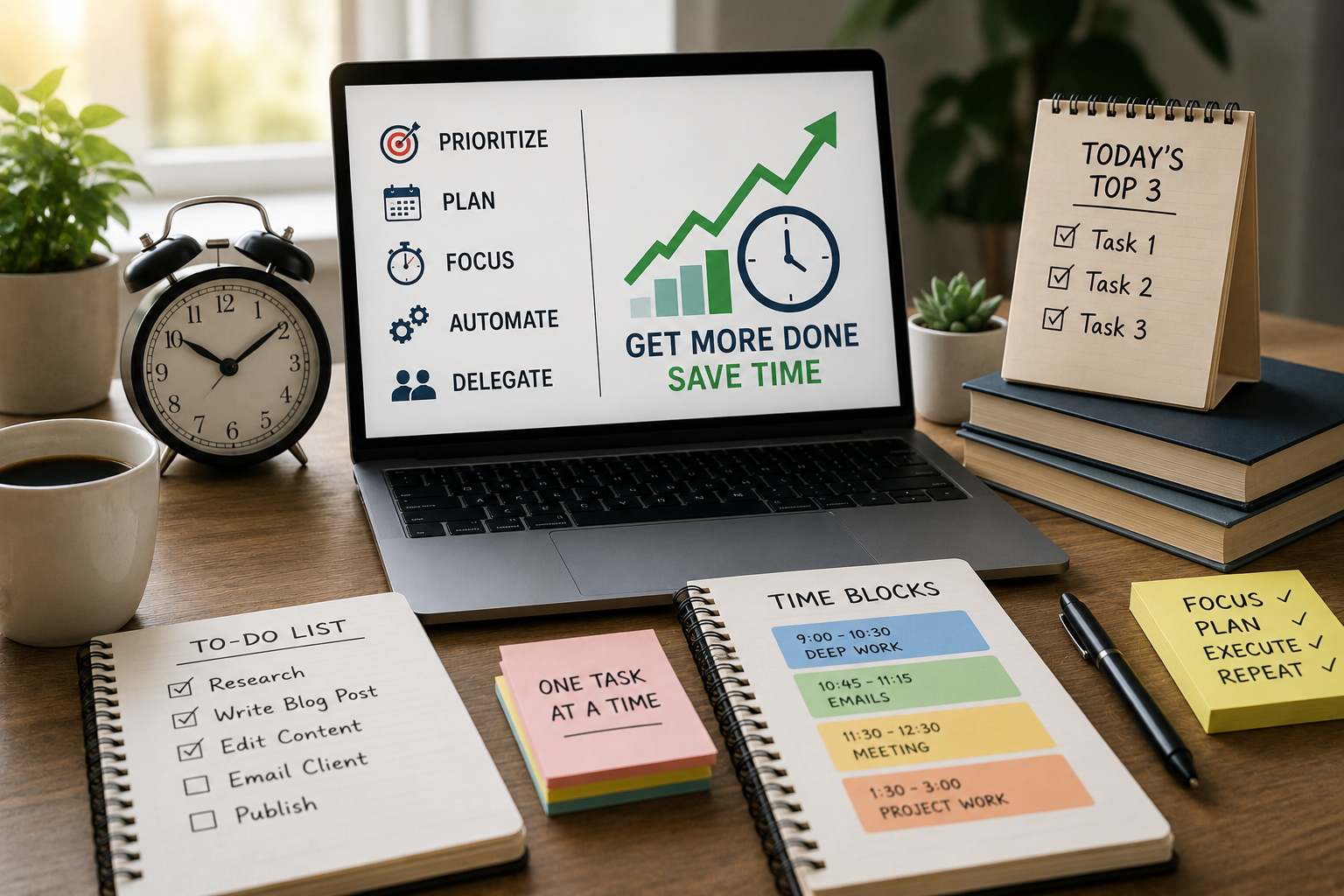
Productivity setup with focus tools

Time feels scarce because demands pile up faster than we can handle. The good news: efficiency isn’t about working harder — it’s about working smarter. This guide gives practical, easy-to-apply time-saving techniques you can use today to finish tasks faster, reduce stress, and get more meaningful work done.

Prioritize with Purpose

Decide what actually matters before you start. Prioritization saves time by preventing busywork.

  • Use the 2×2 priority matrix. Divide tasks into urgent/important, important/not urgent, urgent/not important, and not urgent/not important. Focus on important tasks first.
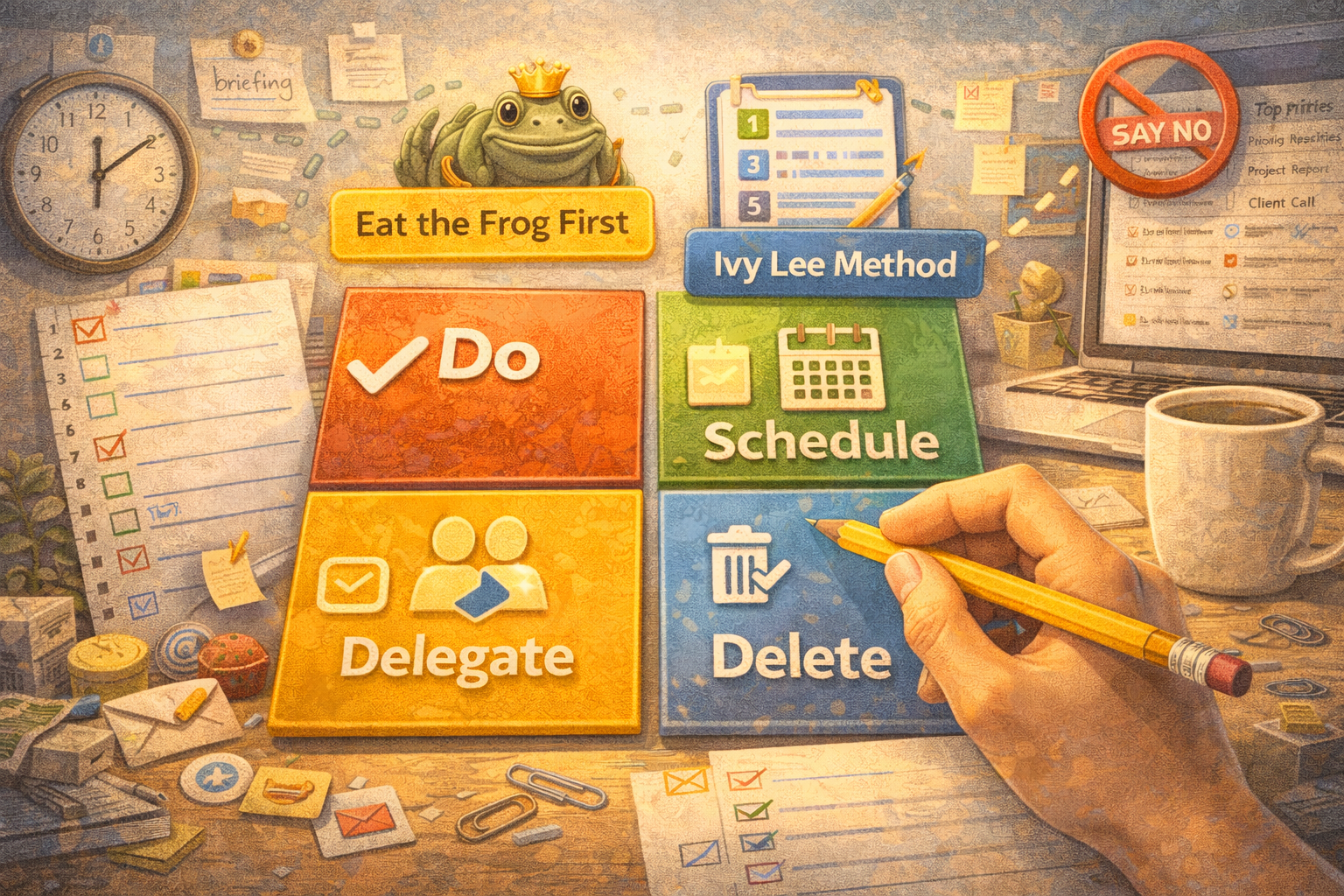
  • Apply the Eisenhower Rule: do, schedule, delegate, or delete. If it’s important and urgent — do it. Important but not urgent — schedule it. Urgent but not important — delegate it. Neither — drop it.
  • Limit your daily top three. Choose three must-complete items each day. Everything else is a bonus.

Batch Similar Tasks

Batching reduces context switching, which wastes time and mental energy.

  • Group emails, calls, and administrative tasks into dedicated blocks. For example, check email three times daily rather than constantly.
  • Batch creative work separately from routine tasks. Use morning blocks for deep creative work and afternoons for meetings and admin.
  • Batch errands: combine trips and do similar tasks back-to-back.

Use Time Blocking

Time blocking turns a to-do list into a schedule so tasks get real estate in your day.

  • Create fixed blocks: deep work, shallow work, breaks, and admin. Stick to the blocks like appointments.
  • Reserve uninterrupted deep-work blocks for your most demanding tasks (60–90 minutes).
  • Protect your blocks by setting boundaries: turn off notifications, close tabs, and let people know your availability.

Apply the Pomodoro Technique

The Pomodoro Technique boosts focus by dividing work into short, intense sprints.

  • Work 25 minutes, rest 5 minutes. After four rounds, take a longer 15–30 minute break.
  • Use a timer or an app to stay honest. Short breaks help sustain energy and prevent burnout.
  • Adjust intervals to fit your attention span (e.g., 50/10 for longer stretches).

Limit Distractions

Distractions are productivity killers. Make them harder to access.

  • Silence nonessential notifications and use Do Not Disturb during focus blocks.
  • Use website blockers for social media or news during work periods.
  • Create a tidy workspace; clutter steals time and attention.

Automate Repetitive Tasks

Automation saves repeated effort and reduces errors.

  • Use email templates for routine replies, canned responses, and keyboard text expanders.
  • Automate file backups, bill payments, and calendar invites.
  • Use workflow tools (Zapier, Make) to move data between apps automatically.

Delegate and Outsource

Delegation multiplies time by letting others do appropriate tasks.

  • Delegate routine or low-impact tasks to teammates or freelancers.
  • Write clear instructions and expected outcomes to avoid back-and-forth.
  • Use platforms (Upwork, Fiverr) for one-off tasks and virtual assistants for ongoing support.

Set Clear Outcomes and Deadlines

Clarity reduces rework and indecision.

  • Define the desired outcome before starting a task: what “done” looks like.
  • Break big tasks into sub-tasks with mini-deadlines.
  • Use a countdown or due-date reminders to stay on track.

Use Checklists and Templates

Checklists keep you consistent and reduce mental overhead.

  • Create standard checklists for recurring processes, meetings, and publishing workflows.
  • Keep templates for emails, briefs, and reports to speed production.
  • Update templates when you find better ways to do things.

Adopt the Two-Minute Rule

Small tasks can be knocked out immediately.

  • If it takes less than two minutes, do it now. This prevents small items from cluttering your list.
  • Combine the rule with batching: do two-minute tasks during short breaks or transition moments.

Leverage Focus-Friendly Tools

Choose tools that support concentration rather than distract.

  • Use minimal note-taking apps (Simplenote, Notion, Obsidian) to capture thoughts quickly.
  • Try distraction-free writing tools (iA Writer, FocusWriter) for drafting.
  • Use task managers with clear prioritization (Todoist, Things, Microsoft To Do).

Optimize Meetings

Poorly run meetings waste hours that could be used for productive work.

  • Only schedule meetings with a clear agenda and desired outcome.
  • Invite only necessary participants and set strict time limits.
  • End with action items and assigned owners, then follow up in writing.

Use Time-Saving Communication Habits

Clear, concise communication reduces back-and-forth.

  • Write short, actionable messages. Lead with the ask, then provide context if needed.
  • Use subject lines and headers that specify required actions or deadlines.
  • Encourage synchronous communication for complex issues, asynchronous for simple updates.

Implement Single-Tasking Over Multitasking

Multitasking reduces efficiency and accuracy.

  • Focus on one task until completion or a logical stopping point.
  • Use visible cues to show colleagues when you’re in focus mode (calendar blocks, status messages).
  • Return to other tasks only after finishing or at scheduled transition points.

Break Projects into Manageable Chunks

Large projects feel overwhelming and stall progress.

  • Use the “divide and conquer” method: split projects into phases and deliverable milestones.
  • Start with a quick, imperfect version (a minimal viable product) to gain momentum.
  • Celebrate small wins to maintain motivation and momentum.

Use Decision Filters

Reduce decision fatigue with simple rules and standards.

  • Establish pre-set criteria for routine choices (meeting lengths, email responses, approval thresholds).
  • Create standard operating procedures for frequent decisions.
  • Limit options for trivial choices (e.g., rotate meals, set a weekly outfit).

Track and Review Your Time


You can’t improve what you don’t measure.

  • Use a time-tracking app for a week to identify where time actually goes.
  • Review weekly to spot patterns and adjust commitments.
  • Reallocate time from low-value activities to high-impact tasks.

Manage Energy, Not Just Time

Productivity follows energy cycles more than the clock.

  • Align difficult tasks with your peak energy periods (morning for many people).
  • Take regular short breaks, move around, hydrate, and get sunlight.
  • Respect sleep and recovery—rest fuels faster, higher-quality work.

Create Routines and Rituals

Habits reduce decision-making and speed execution.

  • Start your day with a consistent routine that primes productivity (planning, light exercise, priority setting).
  • Use pre-task rituals: a 60-second setup to clear your desk, open needed files, and launch a timer.
  • End your day with a shutdown routine: review tomorrow’s top three and close open loops.

Use “No” More Often

Saying no protects focused time and priorities.

  • Practice brief, polite rejections that offer an alternative (e.g., “I can’t this week; I can do it next Tuesday”).
  • Schedule “no-meeting” days to preserve deep-work time.
  • Reassess recurring commitments periodically and drop those that no longer serve goals.

Refine and Simplify Processes

Complex workflows cost time. Simplify where possible.

  • Map your processes and remove unnecessary steps.
  • Combine tools when they duplicate functions.
  • Streamline approvals: reduce layers and set clear thresholds for who signs off.

Leverage Shortcuts and Keyboard Efficiency

Small speed gains add up.

  • Learn keyboard shortcuts for your main tools.
  • Use text expansion to type common phrases or complex data quickly.
  • Customize app macros to automate repeated sequences of actions.

Keep a “To-Do Later” Inbox

A mental dump prevents task paralysis.

  • Create a single capture place for ideas and small tasks.
  • Regularly process the inbox: decide, schedule, delegate, or delete each item.
  • Avoid keeping long-term items in your immediate task list—move them to a project list or calendar.

Use Visual Progress Tools

Seeing progress motivates and keeps you honest.

  • Use Kanban boards (Trello, Notion) to visualize task flow: To Do, Doing, Done.
  • Update progress publicly or with your team to reduce redundant status checks.
  • Count completed tasks to get a morale boost and momentum.

Quick Win Example (Illustration)

Imagine you have a blog post to write, emails to answer, and a meeting. Instead of switching constantly:

  • Block 90 minutes for the blog (deep work), 30 minutes for emails (batch), then the meeting. Use Pomodoro within the 90 minutes: two 40-minute sprints with a 10-minute break. Turn off notifications. If any meeting requires follow-up tasks, delegate the research. End the day by listing the top three tasks for tomorrow. That structure typically reduces spillover and completes the biggest item before meetings hijack your energy.

Common Pitfalls to Avoid

  • Over-scheduling: leaving no buffer causes stress when tasks overrun.
  • Perfectionism: chasing perfect results slows progress—iterate instead.
  • Tool overload: too many apps create friction instead of saving time.
  • Ignoring review: failure to track outcomes means repeating inefficient habits.

Quick Start Checklist

  • Identify today’s top three priorities.
  • Block deep-work time and protect it.
  • Batch small tasks and check email at set times.
  • Use a two-minute rule for tiny tasks.
  • Automate or delegate one repetitive task this week.
  • Track your time for three days to find your biggest drains.

Efficient Task Completion

Efficient task completion combines clear priorities, smart scheduling, focused execution, and ongoing refinement. Start small: pick two techniques from this guide, apply them for a week, then iterate. Over time, these habits compound and give you back meaningful hours every week.
What Are Some Techniques for Managing a Busy Schedule Efficiently?

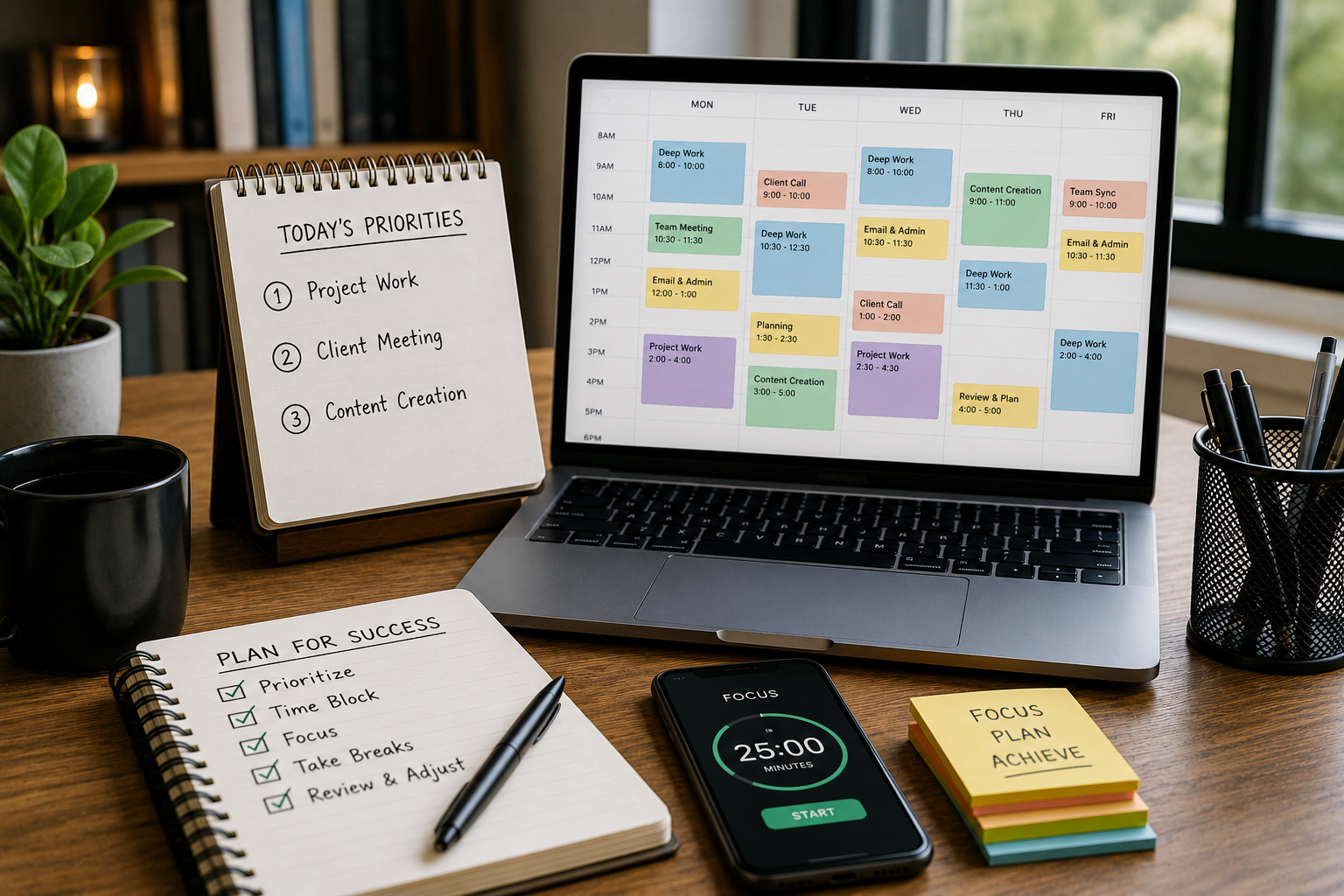
Productivity workspace with clear planning tools

Managing a busy schedule can feel like juggling flaming torches—exciting when it’s working, stressful when one falls. The good news: efficient scheduling isn’t magic. It’s a set of practical, repeatable techniques you can learn and adapt. Below are clear, actionable strategies to help you regain control over time, reduce stress, and get more meaningful work done each day.

Why efficient scheduling matters

A busy schedule isn’t automatically productive. Without structure, tasks expand to fill available time, deadlines sneak up, and important goals get postponed. Efficient scheduling helps you:

  • Focus on high-impact tasks.
  • Reduce decision fatigue from constant context switching.
  • Build predictable routines that boost consistency.
  • Create buffer time to handle interruptions without derailing your day.

Core principles to guide every technique

Before diving into specific methods, keep these principles in mind:

  • Prioritize outcomes, not busyness.
  • Block time for concentrated work.
  • Plan with realistic time estimates.
  • Protect downtime to avoid burnout.
  • Review and adjust weekly.
  1. Start with a weekly plan (top-down planning)
    Why it works: Weekly planning gives a bird’s-eye view of priorities and prevents daily firefighting.
    How to do it:
  • Pick a consistent planning time (Sunday evening or Monday morning).
  • List top 3–5 goals for the week aligned with your major projects or personal priorities.
  • Allocate time blocks for those goals across the week, noting fixed commitments (meetings, appointments).
  • Add one or two “buffer blocks” for overruns and unexpected tasks.
    Tip: Use a single calendar (digital or paper) to avoid double-booking. Color-code categories like “Work,” “Family,” and “Admin.”
  1. Time blocking (batch similar tasks)
    Why it works: Grouping similar tasks reduces context switching and improves focus.
    How to do it:
  • Divide your day into focused blocks (e.g., 60–90 minutes) for specific task types: deep work, admin, calls, email, creative.
  • Schedule the hardest, highest-value work during your peak energy times (morning for morning people, afternoon for others).
  • Include short breaks between blocks (5–15 minutes) to reset.
    Example blocks:
  • 8:30–10:00 — Deep work: project development
  • 10:15–11:00 — Meetings
  • 11:00–12:00 — Emails and admin
  • 2:00–3:30 — Creative tasks
    Tip: Label blocks clearly in your calendar and set meeting-free blocks for deep work.
  1. Prioritization frameworks (decide what really matters)
    Why it works: Not all tasks deserve equal time. Prioritization ensures you spend energy on the right things.
    Techniques:
  • Eisenhower Matrix: Classify tasks as Urgent/Important to decide Do, Schedule, Delegate, or Delete.
  • Pareto Principle (80/20): Identify the 20% of tasks that produce 80% of results and prioritize them.
  • MITs (Most Important Tasks): Each day, choose 1–3 MITs that must be completed.
    How to pick MITs:
  • Ask: Which tasks, if done, will move my projects forward or relieve major stress?
  • Schedule MITs early, when willpower and energy are higher.
  1. Use the “Two-Minute Rule” and task batching for small tasks
    Why it works: Small tasks can clutter your day. Quick decisions prevent buildup.
    How to do it:
  • Two-Minute Rule: If a task takes less than two minutes, do it immediately.
  • Batch small tasks (emails, quick calls, receipts) into a single short block rather than tackling them throughout the day.
    Tip: Reserve a 30-minute slot mid-afternoon for quick admin tasks so they don’t creep into deep-work blocks.
  1. Set clear boundaries and protect your calendar
    Why it works: Without boundaries, others’ urgencies become your daily agenda.
    How to do it:
  • Communicate availability: set “office hours” or meeting windows.
  • Decline or deflect non-essential meetings. Ask for agendas and outcomes before accepting.
  • Use calendar features: block “Focus Time” and set your status to avoid interruptions.
    Example phrases:
  • “I can meet between 2–4 PM on Tuesday; does that work?” (offers a window rather than full availability)
  • “Can you share an agenda? If it’s brief, we can cover it in 15 minutes.”
  1. Delegate and outsource effectively
    Why it works: Delegation multiplies your impact by freeing time for high-value work.
    How to do it:
  • Identify tasks you must do personally versus those others can handle.
  • Create clear instructions and standards when delegating.
  • Use tools or services for repetitive work (virtual assistants, automated invoicing, scheduling tools).
    Tip: Start by delegating one recurring task. Measure outcomes and refine.
  1. Plan for interruptions with buffer time
    Why it works: Interruptions are inevitable. Buffer time prevents them from derailing your plan.
    How to do it:
  • Add 10–20% buffer across your daily schedule or insert short gap blocks between meetings.
  • Use the “15-minute rule”: schedule meetings to end 15 minutes early so you have transition time.
  • Keep a small “parking lot” list for non-urgent interruptions to capture ideas without immediate action.
  1. Use technology wisely—tools that help (not distract)
    Why it works: The right tools streamline scheduling, reminders, and collaboration.
    Recommended tool types:
  • Calendar app with time-blocking and integrations (Google Calendar, Outlook).
  • Task managers that support hierarchies and deadlines (Todoist, Asana, Notion).
  • Focus apps that minimize distraction (Forest, Focus@Will, website blockers).
  • Automation tools (Zapier, Make) to reduce repetitive manual tasks.
    Guideline: Limit the number of tools to avoid app fatigue—choose a core calendar + one task manager.
  1. Time estimation and the Pomodoro Technique
    Why it works: Accurate time estimates make planning realistic; Pomodoro boosts focus and momentum.
    How to do it:
  • Break tasks into chunks and estimate how long each will take. Add 20–30% extra time for unknowns.
  • Use Pomodoro: 25 minutes focused work, 5-minute break; after four cycles, take a longer break (15–30 minutes).
    Benefits: increased sustained focus, clear break structure, easy progress tracking.
  1. Review and reflect weekly (continuous improvement)
    Why it works: Regular reflection helps you spot bottlenecks and improve scheduling habits.
    How to do it:
  • Weekly review (15–30 minutes): check completed tasks, update priorities, capture lessons, and plan next week.
  • Ask these questions: What worked? What didn’t? What will I change next week?
  • Keep a notepad or digital log of recurring issues (frequent interruptions, wrong time estimates) and address them systematically.
  1. Combine personal and professional planning
    Why it works: Life tasks spill into work and vice versa. A unified plan reduces clashes.
    How to do it:
  • Use one calendar for both personal and work events, with private labeling for sensitive items.
  • Block family time, exercise, and sleep as non-negotiable calendar events.
  • Batch personal errands into single blocks to avoid fragmenting workdays.
  1. Energy management, not just time management
    Why it works: Peak energy windows determine when you’ll be most effective.
    How to do it:
  • Track when you feel most alert and schedule demanding tasks then.
  • Build routines for energy: morning sunlight, short walks, consistent sleep, hydration, and healthy snacks.
  • For low-energy times, schedule repetitive or light tasks rather than creative work.
  1. Smart meeting practices
    Why it works: Meetings consume a large portion of modern workdays—make them efficient.
    How to do it:
  • Require a clear agenda and outcome for every meeting.
  • Invite only essential people and keep meetings short (15–30 minutes when possible).
  • Start and end on time; assign a facilitator to keep things on track.
    Tip: For quick alignment, use async updates (recorded video, shared docs) instead of meetings.
  1. Use templates and checklists to save decision time
    Why it works: Templates standardize processes and speed up recurring tasks.
    How to do it:
  • Create templates for frequent emails, meeting agendas, project briefs, and content outlines.
  • Use checklists for multi-step processes (onboarding, launch steps) to avoid omissions.
  • Store templates in a central place (shared drive or project tool).
  1. Fight procrastination with commitment devices
    Why it works: External constraints help when motivation dips.
    How to do it:
  • Public commitments: tell a colleague or friend you’ll complete a task by a set time.
  • Financial or social stakes: use tools (Beeminder-style) that penalize missed commitments.
  • Micro-rewards: promise yourself a small break or treat after finishing an MIT.
  1. Keep a “Not To Do” list
    Why it works: Saying yes to everything steals time from what matters.
    How to do it:
  • Write down tasks, habits, and activities you will avoid (e.g., doomscrolling, non-essential meetings).
  • Review the list weekly and update it as priorities change.
  1. Visualize your day with morning planning
    Why it works: A quick morning plan reduces reactive decisions and sets intention.
    How to do it:
  • Spend 5–10 minutes each morning reviewing the day’s blocks and confirming your MITs.
  • Adjust based on any overnight changes but keep the plan intact where possible.
  1. End-of-day wind-down and reset
    Why it works: A clear shutdown separates work from personal time and improves next-day productivity.
    How to do it:
  • Spend 10 minutes capturing accomplishments, unfinished tasks, and priorities for tomorrow.
  • Clear your workspace and set a next-day starting task to make morning momentum easier.

Common pitfalls and how to avoid them

  • Overcommitting: Protect your calendar by saying no and using buffer time.
  • Poor estimation: Track actual time spent for a few weeks to improve future estimates.
  • Tool overload: Consolidate to a few essential apps and disable redundant notifications.
  • Missing energy alignment: Don’t force deep work at energy lows; restructure your day instead.
  • Not reviewing: Weekly reflection is the single highest-leverage habit to refine systems.

Quick starter checklist (use this in your first week)

  • Choose one calendar and one task manager.
  • Do a 30-minute weekly planning session.
  • Block two daily deep-work periods aligned to your energy.
  • Pick 1–3 MITs each day.
  • Insert 10–15% buffer time into your schedule.
  • Run a 10-minute daily shutdown and a 5–10-minute morning review.

Building Over Time

Efficient schedule management is a skill you build over time. Start small: implement one or two techniques, measure the difference for a week, and iterate. With consistent tweaks—prioritizing outcomes, protecting focus time, and planning realistically—you’ll find your days less chaotic and more productive.

How Can I Prioritize Tasks Effectively and Accomplish More?

How Can I Prioritize Tasks Effectively and Accomplish More

Hey there, busy bee! Ever feel like your to-do list is a never-ending monster that’s eating your time and sanity? You’re not alone. In our jam-packed world, knowing how to prioritize tasks effectively is like having a superpower. It helps you slash stress, boost productivity, and actually get stuff done without burning out. This guide breaks it down into simple, actionable steps so you can accomplish more—without the overwhelm. Let’s dive in and turn chaos into calm!


Why Prioritizing Tasks Changes Everything

Picture this: You’re juggling emails, meetings, that big project, and oh yeah, grabbing coffee before you crash. Sound familiar? Without smart prioritization, important tasks get buried under the urgent fluff. Prioritizing isn’t about doing more—it’s about doing what matters most, first.

Studies from productivity gurus like David Allen (of Getting Things Done fame) show that people who prioritize well finish 20-30% more high-impact work daily. Why? Because it frees your brain from decision fatigue. You stop wasting energy on “what next?” and start crushing goals.

The magic happens when you align tasks with your big-picture wins. Want to hit that promotion, launch your side hustle, or just enjoy more family time? Effective task prioritization puts you in the driver’s seat. Ready to learn how? Let’s get to the good stuff.


Step 1: Master the Eisenhower Matrix for Quick Wins

First up, grab a tool that’s been saving backsides since the 1950s—the Eisenhower Matrix. Named after President Dwight D. Eisenhower (who said, “What is important is seldom urgent and what is urgent is seldom important”), this bad boy sorts your tasks into four quadrants. It’s dead simple and game-changing.

Here’s how it works:

  • Urgent and Important (Do It Now!): Crises, deadlines, or anything that moves the needle on your goals. Example: Fixing a client emergency or prepping for a key presentation. Tackle these first—no excuses.
  • Important but Not Urgent (Schedule It): Long-term gold like exercise, skill-building, or planning your next project. These build your future success. Block time in your calendar for them.
  • Urgent but Not Important (Delegate It): Think endless emails or minor admin. Pass them off to a teammate, app, or virtual assistant if possible.
  • Neither Urgent nor Important (Delete It): Social media scrolls, pointless meetings? Ditch ’em. They’re time thieves.

Quick Tip: Draw a 2×2 grid on paper or use free apps like Todoist or Trello. Dump all your tasks in, then sort. In 10 minutes, your day gets crystal clear. I once had a client who reclaimed two hours daily just by nuking quadrant four tasks. Boom—instant accomplishment boost!

Pro move: Review your matrix every morning. Life changes, so should your priorities.


Step 2: Eat the Frog and Use the Ivy Lee Method

Now that you’ve sorted, it’s time to attack. Mark Twain nailed it: “Eat a live frog first thing in the morning and nothing worse will happen to you the rest of the day.” In productivity speak? Do your hardest, most dreaded task first.

Why? Your willpower peaks in the morning (science backs this—cortisol and focus are high pre-noon). Knock out the frog, and the rest feels like a breeze. Accomplish more? You bet—momentum kicks in like rocket fuel.

Pair it with the Ivy Lee Method, a 100-year-old hack from a productivity whiz:

  1. At day’s end, list your top 6 tasks for tomorrow (no more—keep it focused).
  2. Rank them by true impact, not urgency.
  3. Work solely on #1 until done.
  4. Move to #2, and so on.
  5. Repeat daily, scrubbing unfinished tasks to the next day’s list.

This method forces ruthless prioritization. No multitasking nonsense—just laser focus. One study from the University of California found single-taskers outperform multitaskers by 40%. Try it for a week; you’ll wonder how you survived without it.

Light-hearted hack: Name your frogs! “Math Homework Monster” or “Email Avalanche.” Laughing at them shrinks their power.


Step 3: Say No Like a Pro and Set Boundaries

Here’s a tough truth: You can’t do it all. Prioritizing means saying no to good things so great things can happen. Warren Buffett sums it up: “The difference between successful people and really successful people is that really successful people say no to almost everything.”

Audit your yeses. Does this task align with your top 3 goals? If not, politely decline. Script it: “Thanks for thinking of me, but I’m focusing on [priority] right now.”

Set boundaries too:

  • Time block your calendar: Use Google Calendar to chunk your day—deep work 9-11 AM, emails 4-5 PM.
  • Batch similar tasks: Answer all messages at once, not ping-pong style.
  • Weekly review: Sunday evenings, scan wins, flops, and adjust.

Tools like RescueTime track where your time vanishes (spoiler: often cat videos). Apps such as Focus@Will or Forest gamify focus with music and tree-growing rewards. Fun, right?

Real talk: Boundaries prevent burnout. One entrepreneur I coached added “no-meeting Wednesdays” and doubled output. Accomplish more by doing less—counterintuitive but true.


Tackle Procrastination and Build Momentum

Even with priorities set, procrastination sneaks in. Beat it by breaking tasks into micro-steps. “Write report” becomes “Open doc, jot 3 bullet points.” Wins stack up, dopamine flows, and suddenly you’re in the zone.

Use the 2-Minute Rule from David Allen: If it takes under 2 minutes, do it now. Quick wins clear mental clutter.

For bigger beasts, try the Pomodoro Technique: 25 minutes focused work, 5-minute break. Apps like Tomato Timer make it effortless. After 4 cycles, take 15-30 minutes off. Science says this matches your brain’s natural rhythm—productivity soars 25%.

Track progress visually. A simple streak calendar (don’t break the chain!) or apps like Habitica (RPG-style quests) turn chores into adventures. Light-hearted motivation keeps you going.


Leverage Tech and Team Power

Solo heroics are overrated. Tech tools supercharge prioritization:

ToolBest ForWhy It Rocks
NotionAll-in-one planningCustom matrices, databases, and templates—free tier rocks.
AsanaTeam tasksVisual boards, deadlines, and auto-prioritization.
ClickUpEverythingAI sorts tasks by urgency; integrates with 1,000+ apps.
TodoistPersonal listsKarma points for streaks—gamified fun!

For teams, hold 15-minute stand-ups: “Top 3 tasks today? Blockers?” Delegate like a boss.

Outsource the rest. Fiverr or Upwork for one-offs; tools like Zapier automate repeats (e.g., email sorting).


Common Pitfalls and How to Dodge Them

Watch out for these traps:

  • Shiny Object Syndrome: New ideas distract. Park them in a “someday” list.
  • Perfectionism: Done beats perfect. Set time limits.
  • Overloading: Max 3-5 priorities per day. Quality over quantity.
  • Ignoring energy levels: Schedule tough tasks for your peak hours (morning person? Evening owl?).

Review weekly: What worked? Tweak and repeat. Consistency turns prioritization into a habit.


Real-Life Wins: Stories That Inspire

Meet Sarah, a marketer drowning in tasks. She adopted the Eisenhower Matrix and Ivy Lee—cut her workload by 30%, landed a promotion. Or Mike, dad of two: Time blocking gave him evenings free. “I accomplish more at work and home,” he says.

These aren’t unicorns—you can do it too. Start small: Pick one method today.


Your Action Plan to Accomplish More Today

Ready to prioritize like a pro? Here’s your starter kit:

  1. Tonight: List top 6 tasks, Eisenhower them.
  2. Morning: Eat the frog.
  3. Say no to one non-essential thing.
  4. Time block tomorrow.
  5. Evening review: Celebrate wins!

Scale up with tools and habits. In a month, you’ll accomplish more with less effort. You’ve got this—go turn that to-do list into a done list!

What are some effective methods for setting and achieving goals?

Goal setting is a powerful tool for personal and professional development, enabling individuals to turn dreams into reality. However, merely setting goals is not enough; the key lies in crafting and executing an effective plan to achieve them. In this comprehensive article, we will explore proven methods and strategies for setting and achieving goals. From the importance of SMART goals to the power of visualization, time management, accountability, and resilience, these methods will empower you to not only set ambitious goals but also see them through to successful fruition.

Section 1: Setting SMART Goals

Specific
Clearly define your goals with specific details. Vague goals are challenging to pursue.
Example: Instead of “Get in shape,” specify “Lose 10 pounds in three months by exercising three times a week and following a balanced diet.”

Measurable

Establish criteria to measure your progress. It allows you to track your journey and stay motivated.
Example: Track your weekly weight loss and inches lost to measure progress toward your fitness goal.

Achievable
Ensure your goals are attainable and realistic. Overly ambitious goals can lead to discouragement.
Example: If you’ve never run before, don’t set a goal to complete a marathon in a month.

Relevant
Align your goals with your values and long-term objectives. Relevant goals provide purpose and motivation.
Example: If your career goal is to become a chef, taking a coding course might not be relevant.

Time-bound
Set a deadline for your goals. A timeline adds a sense of urgency and prevents procrastination.
Example: “I will finish writing my book by the end of this year.”

Section 2: The Power of Visualization

Create a Clear Mental Image
Visualization involves vividly imagining yourself achieving your goals. This mental rehearsal can enhance motivation and self-confidence.
Example: Before a presentation, visualize yourself speaking confidently and the audience responding positively.

Engage All Senses
Make your visualizations immersive by engaging all your senses. Feel the emotions, hear the sounds, and see the details of your success.
Example: If your goal is to travel to a specific destination, imagine the sights, sounds, and even the scents you’ll encounter.

Regular Practice
Visualization is most effective when practiced consistently. Spend a few minutes each day visualizing your goals.
Example: Athletes often visualize their performance before a big game or competition.

Section 3: Effective Time Management

Prioritize Tasks
Use techniques like the Eisenhower Matrix to distinguish between urgent and important tasks. Focus on what truly matters.
Example: Spend more time on high-impact projects rather than responding to every email.

Break Goals into Smaller Steps
Divide larger goals into smaller, manageable tasks. This approach prevents overwhelm and promotes steady progress.
Example: If your goal is to learn a new language, break it down into daily vocabulary practice and grammar exercises.

Set Deadlines
Deadlines create a sense of urgency and help you allocate your time effectively. Be realistic but firm with your timeframes.
Example: Set a deadline for completing each step toward your goal.

Section 4: Accountability and Support

Share Your Goals
Sharing your goals with a trusted friend, family member, or colleague can hold you accountable and provide valuable support.
Example: If you’re aiming to run a marathon, tell a friend who can join you in training.

Join a Group or Find a Mentor
Participating in a group pursuing similar goals or finding a mentor can provide guidance, motivation, and accountability.
Example: Join a writing group if your goal is to finish a novel, or seek a mentor in your desired career field.

Regular Check-Ins
Schedule regular check-ins with yourself or your accountability partner to assess progress, make adjustments, and stay on track.
Example: Set a monthly meeting to review your financial goals and adjust your budget accordingly.

Section 5: Resilience and Adaptability

Embrace Failure as Learning
Expect setbacks along the way. Instead of seeing them as failures, view them as opportunities for growth and learning.
Example: If a business venture doesn’t succeed, analyze what went wrong and apply those lessons to future endeavors.

Adapt to Changing Circumstances
Life is dynamic, and circumstances can change. Be flexible and willing to adjust your goals as needed.
Example: If a career change becomes necessary, be open to exploring new opportunities and skill development.

Stay Persistent
Persistence is a key factor in achieving long-term goals. Even when faced with challenges, stay committed to your vision.
Example: Authors often face numerous rejections before getting their first book published. Persistence is what sets them apart.

Setting and achieving goals is a transformative journey that demands dedication, strategy, and resilience. By adopting the SMART goal framework, harnessing the power of visualization, practicing effective time management, seeking accountability and support, and embracing setbacks as learning opportunities, you can navigate this path with confidence. Remember that goals are not merely destinations but opportunities for personal growth and fulfillment. Whether your aspirations are personal or professional, these effective methods can guide you toward success and a more fulfilling life.

What are the benefits of time management in achieving goals?

Time management is a vital skill that enables individuals to allocate their time effectively and efficiently towards achieving their goals. By mastering the art of time management, individuals can experience a multitude of benefits in various aspects of their lives. This article explores the significant advantages of time management in goal achievement, including increased productivity, reduced stress levels, improved focus and prioritization, enhanced self-discipline, and the creation of a healthy work-life balance.

Increased Productivity
One of the most evident benefits of time management is the substantial increase in productivity. Effective time management techniques, such as setting clear goals, creating schedules, and using productivity tools, enable individuals to utilize their time more efficiently. By allocating specific time slots to each task, individuals can avoid wasting time on unimportant activities and focus on the tasks that align with their goals. This focused approach helps in achieving more tasks within a given timeframe.

Reduced Stress Levels
Proper time management significantly reduces stress levels. When individuals have a clear plan and schedule, they feel more in control of their time and are better equipped to handle tasks and deadlines. By avoiding procrastination and last-minute rushes, individuals can complete their tasks without the added pressure of time constraints. This reduces stress and allows for a calmer and more composed approach to work. Furthermore, effective time management also allows individuals to allocate time for breaks and relaxation, promoting mental and emotional well-being.

Improved Focus and Prioritization
Time management encourages individuals to prioritize their tasks based on their importance and urgency. By setting clear priorities, individuals can focus their energy and attention on the most critical tasks, thereby maximizing their productivity. Moreover, time management techniques, such as the Eisenhower Matrix or the Pomodoro Technique, help individuals break down their tasks into manageable chunks, enhancing focus and preventing overwhelm. With improved focus and prioritization, individuals can make steady progress towards their goals and achieve meaningful results.

Enhanced Self-Discipline
Time management cultivates self-discipline, which is a crucial trait for success. Through effective time management, individuals learn to resist the temptations of distractions and procrastination. By adhering to schedules and deadlines, individuals develop the discipline to stay committed to their tasks and resist the allure of time-wasting activities. This self-discipline ensures that individuals consistently work towards their goals, even when faced with challenges or setbacks. With enhanced self-discipline, individuals become more reliable and can be trusted to complete tasks efficiently, thus increasing their chances of accomplishing their goals.

Creation of a Healthy Work-Life Balance
Achieving a healthy work-life balance is a significant benefit of time management. With proper time allocation, individuals can devote sufficient time and energy to their personal lives, including family, hobbies, and self-care. By setting boundaries and sticking to schedules, individuals can avoid overworking and burnout, leading to a more fulfilling and balanced life. Time management enables individuals to identify and eliminate time-wasting activities, freeing up time for activities that bring joy and fulfillment. This balance not only improves overall well-being but also enhances productivity when individuals return to work with a refreshed mind and renewed motivation.

Time management is a powerful tool that propels individuals towards achieving their goals. By embracing effective time management techniques, individuals can experience a range of benefits, including increased productivity, reduced stress levels, improved focus and prioritization, enhanced self-discipline, and the creation of a healthy work-life balance. Mastering time management is key to unlocking success and leading a fulfilling life.

What Hours Are You Most Productive?

Productivity is not just about how much time we spend working, but also about when we work. Our energy, focus, and creativity fluctuate throughout the day, and understanding our natural rhythms can help us optimize our productivity and achieve our goals more efficiently. In this article, we’ll explore the question of what hours are most productive for different people and how to find your own optimal work hours.


The science of productivity and circadian rhythms
Our natural sleep-wake cycle, also known as the circadian rhythm, plays a significant role in our productivity levels. Our bodies are designed to be active during the day and to rest at night, and this cycle is regulated by the hormone melatonin. Melatonin levels increase in the evening and decrease in the morning, helping us to fall asleep and wake up naturally.
According to research, our cognitive performance also follows a similar pattern, with most people experiencing peak performance in the morning and early afternoon, followed by a dip in the mid-afternoon and a recovery in the early evening. This pattern is known as the “circadian trough” and is believed to be related to the body’s natural energy cycle.


Individual differences in productivity
While most people experience a peak in productivity in the morning and early afternoon, there are individual differences in productivity patterns. Some people are “morning people” who feel most alert and focused in the early hours of the day, while others are “night owls” who prefer to work in the late afternoon and evening.


These differences are largely determined by genetics and are referred to as “chronotypes.” According to research, about 50% of people are morning types, 20% are evening types, and the rest fall somewhere in between. Morning types tend to have a stronger circadian rhythm and are more alert and focused in the morning, while evening types have a weaker circadian rhythm and are more alert and focused in the evening.


How to find your optimal work hours
Finding your optimal work hours requires some experimentation and self-awareness. Here are some tips on how to discover your natural productivity patterns:

  1. Track your energy levels throughout the day: Keep a journal or use an app to track your energy levels and mood throughout the day. Notice when you feel most alert, focused, and productive, and when you feel tired or distracted.
  2. Experiment with different schedules: Try working at different times of the day and notice how you feel. For example, if you’re a morning person, try waking up earlier and working before breakfast. If you’re an evening person, try working in the late afternoon or evening.
  3. Pay attention to your body’s signals: Notice when you feel hungry, thirsty, or need a break. Taking care of your physical needs can help you maintain energy and focus throughout the day.
  4. Build breaks into your schedule: Schedule regular breaks throughout the day to recharge and refocus your energy. This could be a short walk, a meditation session, or a conversation with a colleague.
  5. Find your “flow” state: “Flow” is a state of deep focus and immersion in a task that is challenging but achievable. Notice when you experience this state and try to replicate the conditions that help you get into the flow.
  6. Be flexible: Remember that productivity is not just about working harder or longer but also about working smarter. Be open to adjusting your schedule and routines as needed to optimize your productivity.
    The question of what hours are most productive depends on individual factors such as chronotype and natural rhythms. While most people experience a peak in productivity in the morning and early afternoon, there are individual differences that should be taken into account. By tracking your energy levels, experimenting with different schedules, and paying attention to your body’s signals, you can find your optimal work hours and achieve your goals more efficiently. Remember that productivity is not just about working harder or longer but also about working smarter, and finding the right balance of work and rest can help you achieve your goals while maintaining your health and well-being.
    It’s also important to note that our optimal work hours can vary depending on the type of work we’re doing. For example, creative tasks that require a lot of imagination and brainstorming may be better suited for certain times of day. Research has shown that people tend to be more creative during their non-optimal times, such as in the evening for morning people and in the morning for evening people. This may be because our brains are less inhibited during these times, allowing us to think more freely and make new connections.
    On the other hand, tasks that require a lot of focus and concentration, such as analyzing data or writing reports, may be better suited for our optimal work hours when we’re most alert and focused. By understanding these nuances, we can schedule our workday in a way that maximizes our productivity and efficiency.
    Another factor that can impact our productivity is our environment. Some people work best in a quiet, organized space, while others thrive in a more dynamic and social setting. If you work in an office, you may not have much control over your environment, but you can make small adjustments to create a more productive space. For example, you could try using noise-cancelling headphones or moving to a quieter area of the office if you need to focus. If you work from home, you have more control over your environment, and you can experiment with different settings to find what works best for you.
    Finally, it’s important to remember that productivity is not just about work. Taking care of our physical and mental health is essential for maintaining our energy and focus throughout the day. This includes getting enough sleep, eating a healthy diet, staying hydrated, and engaging in regular exercise and stress-relieving activities. Taking breaks throughout the day to rest and recharge can also help us stay productive and focused.
    In summary, finding your optimal work hours is a process of experimentation and self-awareness. By tracking your energy levels, experimenting with different schedules and environments, and taking care of your physical and mental health, you can find the right balance of work and rest to optimize your productivity and achieve your goals. Remember that everyone is different, and what works for one person may not work for another, so be patient and flexible as you explore your own natural rhythms and patterns. With a little effort and attention, you can unlock your full potential and achieve your goals more efficiently and effectively.