
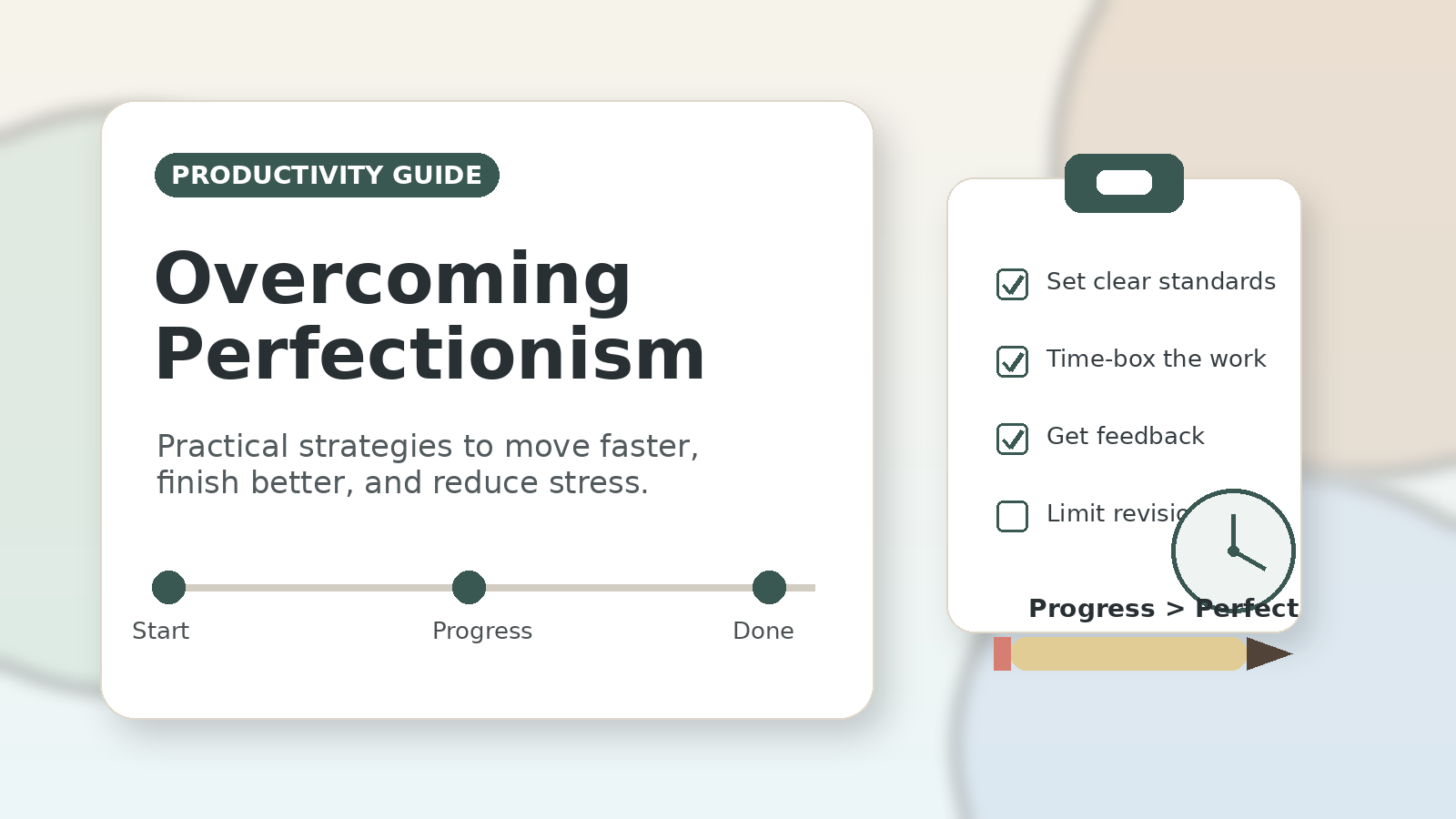
Overcoming Perfectionism and Increasing Efficiency: Practical Strategies That Work

overcoming-perfectionism-efficiency

Perfectionism can feel like a high standard that pushes you forward — until it becomes a roadblock. When every task feels like it requires flawless execution, progress slows, decisions stall, and stress rises. The good news: you can keep high standards without letting perfectionism destroy your productivity. This post gives clear, actionable strategies to break perfectionist habits, boost efficiency, and get more meaningful work done with less stress.

What perfectionism looks like (so you can spot it)

  • You delay starting projects because you want the “perfect” plan.
  • You over-edit and spend excessive time polishing small details.
  • You avoid tasks where failure is possible, or you say “yes” to everything to control outcomes.
  • You obsess over worst-case scenarios and repeatedly revise work beyond value.
    Recognizing these patterns helps you choose the right strategy to change them.

Shift your mindset: good-enough vs. perfect

  • Set outcome-focused standards. Decide what success looks like for each task in measurable terms: “publish with 80% of features working” vs. “perfect product.”
  • Reframe mistakes as learning. Treat errors as feedback rather than proof of inadequacy. This reduces fear and frees you to act.
  • Use time-limited experiments. Commit to trying something imperfect for a short period (e.g., a one-week prototype) to gather real data before refining.
    These mindset shifts reduce the paralysis that perfectionism causes and encourage iteration over stagnation.

Plan for progress: break tasks into manageable steps

  • Use micro-tasks. Break large projects into 15–60 minute tasks you can complete in one sitting. Completing small items builds momentum.
  • Prioritize by impact, not by perfectability. Focus first on tasks that move outcomes forward (client deliverables, launch-critical work) rather than on cosmetic improvements.
  • Apply the 80/20 rule. Identify the 20% of work that delivers 80% of the result and tackle that first.
    Small, prioritized steps accelerate forward motion and keep perfectionist impulses in check.

Set practical time limits and guardrails

  • Time-box work sessions. Work in fixed blocks (e.g., Pomodoro: 25–50 minutes with short breaks). When the timer ends, stop and assess progress.
  • Create “finish” rules. Decide beforehand what counts as “done” for a task (deliverable quality, required checks). When those rules are met, stop refining.
  • Use deadlines as positive constraints. Deadlines focus attention and reduce endless tweaking. Prefer realistic but slightly tight deadlines to fight over-polishing.
    Time constraints create healthy pressure and force decisions rather than endless tweaking.

Develop iteration and feedback loops

  • Prototype quickly. Build minimal viable versions (drafts, mock-ups) to test ideas before perfecting them. Real-world feedback beats guesswork.
  • Seek targeted feedback. Ask specific questions: “Is this idea clear?” or “Which part is confusing?” General requests invite vague criticism that fuels doubt.
  • Schedule short review cycles. Regular, quick reviews (daily or weekly) allow steady improvement without massive rework.
    Iterative work reduces wasteful perfectionism by making improvements based on evidence, not assumption.

Adopt effective productivity systems

  • Use to-do lists with clear priorities. Keep a weekly master list and daily top-3 tasks. Completing top priorities protects progress.
  • Batch similar tasks. Group similar activities (email, editing, calls) to reduce context switching and decision fatigue.
  • Automate and delegate. Remove repetitive tasks through tools or hand them to others when possible. Perfectionists often try to control everything; delegation frees time for higher-impact work.
    Systems reduce friction and stop perfectionism from choking productivity.

Practice decision-making frameworks

  • Use the “two-minute rule.” If it takes less than two minutes, do it now. This prevents small items from piling up into big mental clutter.
  • Apply a decision threshold: OK vs. Excellent. For lower-impact tasks, choose “OK” and move on; reserve “Excellent” for top-priority work.
  • Use time-based decisions. Spend a fixed amount of time deciding, then commit. Overthinking decisions is a common perfectionist trap.
    Clear rules make decisions faster and reduce the need for endless refinement.

Control your environment to reduce friction

  • Minimize distractions. Remove notifications, tidy your workspace, and prepare what you need before starting a focused session.
  • Create a “start” ritual. A simple routine (making coffee, opening a project template) signals your brain it’s time to work and reduces initial resistance.
  • Designate finishing cues. End-of-session rituals (saving files, noting next steps) help you stop working without obsessing over small changes.
    An environment tuned for focus limits the small interruptions that perfectionists magnify.

Manage emotions and self-talk

  • Name the fear. Are you afraid of criticism, rejection, or making a mistake? Naming the fear reduces its power and clarifies what you can do about it.
  • Replace “must” with “choose.” Swap statements like “I must do this perfectly” with “I choose to do this well enough to achieve X.” This subtle language shift reduces pressure.
  • Practice self-compassion. Treat yourself as you would a teammate; being kind lowers anxiety and improves learning.
    Managing emotions directly reduces the internal drivers of perfectionism and allows steadier work.

Use measurable goals and metrics

  • Define specific, measurable goals. Instead of “write a post,” aim for “write 1,200 words by 3 PM.” Concrete targets make progress visible.
  • Track progress with simple metrics. Time spent, tasks completed, conversion rate improvements — choose metrics that matter and celebrate gains.
  • Review results, not intent. Evaluate based on outcomes (did it achieve the goal?) rather than how perfect it felt during the process.
    Objective measures shift the focus from subjective perfection to real-world impact.

Limit revision cycles

  • Cap the number of revisions. Decide, for example, three rounds of edits maximum. Each round should address clearly defined issues.
  • Use versioning. Save milestone versions (v1, v2) and treat each as an opportunity to iterate rather than an incomplete final.
  • End with a confidence check. Ask, “Would this meet the minimum standard if a client saw it now?” If yes, publish.
    Capping revisions prevents endless tinkering and encourages completion.

Build habits that reduce perfectionist impulses

  • Routine over inspiration. Establish regular work times so you rely less on feeling “inspired” and more on consistent action.
  • Start before you feel ready. Force small initial actions (open file, write the first sentence) to break the perfectionist stall.
  • Reward progress, not perfection. Celebrate finished items and incremental wins to reinforce productive behavior.
    Habits make it easier to act despite perfectionist doubts.

Practical exercises to rewire behavior

  • The 80% challenge: Deliver work at 80% quality and track results. Notice how much improvement actually matters when you get real feedback.
  • The 1-hour prototype: Build a quick version of a project in one hour. Use it to test assumptions and gather data.
  • Public accountability: Share a simple promise (tweet, team message) with a deadline. Public commitment increases follow-through.
    These exercises build tolerance for imperfection and show you the payoff of moving faster.

When to aim for excellence instead of “good enough”

  • High stakes or safety-critical tasks need near-perfection. Identify the few tasks where higher investment is justified.
  • When you’re building a long-term reputation or a signature product, invest more time but still use staged improvement and feedback.
  • Use selective perfection: aim for excellence on the small number of things that truly matter; accept “good enough” elsewhere.
    This selective approach balances quality and efficiency without abandoning standards.

Technology and tools that help

  • Task managers: Asana, Todoist, Notion for prioritization and progress tracking.
  • Time tools: Pomodoro timers, Focus apps (Forest, Focus@Will) to enforce time-boxing.
  • Collaboration tools: Shared docs and comment threads for targeted feedback and version control.
  • Automation: Templates, macros, and workflow automations to remove repetitive perfectionist busywork.
    Tools are only helpful if you use them with clear rules—avoid turning tools into new perfection traps.

Dealing with setbacks and slip-ups

  • Expect backsliding. Perfectionist habits are persistent; treat setbacks as normal and refocus quickly.
  • Analyze, don’t ruminate. When you stall, list the real obstacles and choose one small action to move forward.
  • Recommit to rules. Reset time limits, finish rules, or revision caps when you notice slippage.
    A forgiving, pragmatic recovery process keeps momentum even when perfectionist tendencies return.

Practical weekly routine to increase efficiency

  • Monday: Set weekly outcomes and top 3 priorities. Time-box planning to 30–45 minutes.
  • Daily: Start with the top-priority micro-task for 60–90 minutes. Use Pomodoro sessions for focus.
  • Mid-week: Prototype or collect feedback on progress. Limit revisions to scheduled review slots.
  • Friday: Review metrics, decide what needs improvement, and archive the week’s “done” items. Celebrate progress.
    A short, consistent routine makes finishing tasks normal and reduces perfectionist stalls.

Quick checklist to use before deciding “not done”

  • Does this meet the predefined success criteria? If yes, publish or move on.
  • Will further refinement change the outcome materially? If no, stop.
  • Is this work on a high-impact item that warrants more time? If no, accept “good enough.”
  • Have I asked for targeted feedback? If not, get feedback and revisit only if necessary.
    Use this checklist as a final gate to prevent endless tweaking.

Conclusion: act imperfectly, learn quickly, improve meaningfully

Perfectionism steals time and momentum. The antidote is practical: set clear standards, time-box work, break tasks into tiny steps, get evidence through prototypes, and limit revisions. Combine mindset shifts with concrete systems—prioritization, time limits, and feedback loops—to move faster and smarter. Over time, incremental changes add up: you’ll produce higher-quality work with less stress and more impact.

How Can I Stay Motivated and Avoid Burnout While Working Towards Your Objectives?

How Can I Stay Motivated and Avoid Burnout While Working Towards Your Objectives

Hey there, goal-chaser! Chasing dreams is exciting, but let’s be real—sometimes it feels like you’re running on a hamster wheel that’s about to snap. That nagging burnout? Yeah, it’s the uninvited guest that crashes your motivation party. But don’t worry! This guide is your fun, no-nonsense roadmap to staying pumped up and dodging exhaustion while smashing those objectives. We’ll break it down into simple, actionable steps that actually work. Ready to turn “ugh” into “yes!”? Let’s dive in.


Set SMART Goals That Spark Joy

First things first: vague goals are motivation killers. Ever said, “I’ll get fit” and then binged Netflix instead? Yeah, me too (hypothetically speaking). The fix? Go SMART—Specific, Measurable, Achievable, Relevant, and Time-bound. This isn’t some boring corporate jargon; it’s your secret weapon for feeling like a boss.

Picture this: Instead of “work on my side hustle,” try “spend 30 minutes daily writing 500 words for my blog, three days a week, until I hit 10 posts by month’s end.” Boom—specific and doable. Why does this beat burnout? It gives your brain quick wins. Check off that daily task, and dopamine floods in like confetti at a party.

Make it fun: Tie goals to rewards. Nail your writing sprint? Treat yourself to a fancy coffee. Studies from psychologists like BJ Fogg show tiny habits build momentum without overwhelming you. Track progress in a colorful app like Habitica—gamify it! Turn chores into quests, and suddenly you’re leveling up instead of crashing.

Pro tip: Review goals weekly. Ask, “Does this still light me up?” If not, tweak it. Flexible goals keep motivation alive and burnout at bay.


Build a Routine That Feels Like Play, Not Work

Routines sound rigid, but think of them as your personal hype playlist. Without one, you’re winging it, and chaos breeds burnout faster than you can say “procrastination.”

Start small: Block your day into “power hours.” Mornings for deep work (when your energy peaks), afternoons for lighter tasks. Use the Pomodoro technique—25 minutes focused, 5-minute break. Apps like Focus Booster make it effortless. During breaks, stretch, doodle, or dance to your jam. No scrolling doom-feed; that’s motivation kryptonite.

Incorporate joy bursts. Love podcasts? Listen while commuting to your home office. Crave nature? Walk meetings beat desk slumps. Research from the American Psychological Association shows routines reduce decision fatigue—fewer choices mean less mental drain.

Nightly wind-downs are gold. Dim lights, journal three wins (even tiny ones), and plan tomorrow’s top three tasks. Sleep 7-9 hours; it’s non-negotiable. Skimp on Zzzs, and cortisol (stress hormone) skyrockets, inviting burnout.

Here’s a sample daily flow for goal warriors:

  • 6 AM Wake-up: Hydrate, meditate 5 mins.
  • 7-9 AM Power Hour: Core objective work.
  • 9-9:25 AM Pomodoro Sprint: Tackle emails.
  • Breaks: Snacks, stretches, laughs (funny cat videos count).
  • Evening: Reflect, reward, recharge.

Mix it up weekly to avoid routine rut. One week yoga, next dance cardio. Fun keeps the fire burning!


Prioritize Self-Care: Your Burnout Shield

Self-care isn’t fluffy spa days—it’s your daily armor. Ignore it, and burnout sneaks in like a ninja. We’re talking basics that recharge your battery.

  • Fuel Right: Ditch sugar crashes. Eat balanced—veggies, proteins, whole grains. Hydrate like it’s your job (aim for 8 glasses). Coffee? One cup, then green tea for steady energy. A study in the Journal of Nutrition found omega-3s (from salmon, nuts) boost mood and focus.
  • Move It: Exercise isn’t punishment; it’s motivation magic. 30 minutes daily—walks, yoga, or Zumba. Endorphins crush stress. Bonus: Nature walks double as creative brainstorming for your goals.
  • Mind Matters: Stress? Breathe deep. Try 4-7-8 breathing: Inhale 4 seconds, hold 7, exhale 8. Apps like Calm guide you. Gratitude journaling flips negativity—list three things you’re thankful for nightly.
  • Social Fuel: Connect! Weekly calls with cheerleaders (friends, mentors). Share wins; accountability skyrockets motivation. Join online communities like Reddit’s r/GetMotivated for virtual high-fives.
  • Boundaries are key: Say no to energy vampires. Work emails after 7 PM? Nope. Protect your “off” time fiercely.
  • Spot burnout early: Signs like irritability, endless fatigue, or goal dread. When they hit, pause. One day off can reset everything.

Find Your “Why” and Surround Yourself with Inspiration

Motivation dips when your “why” fades. Dig deep: Why this objective? World domination? Family legacy? Write it big, stick it on your wall.

  • Visualize success daily. Morning ritual: 5 minutes imagining the win—feeling the pride, hearing applause. Athletes do this; science backs it (neuroplasticity rewires your brain for success).
  • Inspiration squad: Curate feeds—podcasts like “The Tim Ferriss Show,” books like “Atomic Habits” by James Clear. Follow motivators on Instagram (but limit to 10 minutes!).
  • Accountability hacks: Buddy system—pair with a goal twin for check-ins. Public commitments (social media shares) leverage social pressure positively.
  • When slumps hit, “reset rituals”: Power playlist, motivational movie (Rocky vibes), or nature escape. Change scenery sparks fresh energy.

Tackle Obstacles Head-On with Playful Problem-Solving

Obstacles? They’re plot twists, not endings. Perfectionism stalling you? Embrace “good enough.” Ship messy first; refine later.

  • Procrastination? “2-minute rule”: If a task takes under 2 minutes, do it now. Bigger? Break into micro-steps.
  • Distractions? Environment hack: Phone in another room, noise-cancelling headphones with focus music (lo-fi beats rock).
  • Track triggers: Bad days? Mood journal reveals patterns (e.g., skipped breakfast = cranky). Adjust proactively.
  • Long-term: Quarterly “motivation audits.” What’s working? Ditch what’s not. Pivot without guilt—goals evolve.

Celebrate milestones! Big or small—dance parties, high-fives. Positive reinforcement wires your brain for more wins.


Long-Term Strategies: Make Motivation a Lifestyle

Sustainability beats intensity. Batch tasks: Mondays for planning, Tuesdays for creation. Automate where possible (tools like Zapier).

  • Learn continuously: Short courses on Udemy for skill boosts without overwhelm. Mastery fuels passion.
  • Mindset shift: Growth mindset (Carol Dweck’s research)—failures are lessons, not defeats. Reframe “I failed” to “I’m learning.”
  • Community power: Masterminds or local groups. Shared energy multiplies yours.
  • Rest intentionally: Weekly “no-goal Sundays.” Recharge fully to sprint Monday.
  • Measure holistic progress: Not just objectives, but energy levels, joy, relationships. Balanced life = sustained motivation.

Your Motivation Makeover Starts Now

Staying motivated and sidestepping burnout boils down to smart goals, joyful routines, fierce self-care, a rock-solid “why,” obstacle-crushing tactics, and lifestyle hacks. It’s not about grinding harder—it’s working smarter with fun infused.

Pick one tip today: SMART-ify a goal or try Pomodoro. Small steps snowball into epic progress. You’ve got this—go be the unstoppable you!

How can mindfulness practices help in increasing productivity?

In today’s fast-paced world, productivity is often equated with constant hustle and unceasing activity. However, there’s a profound paradox at play—slowing down through mindfulness practices can significantly enhance productivity. Mindfulness, rooted in ancient contemplative traditions, involves being fully present and aware of the moment. In this article, we explore how mindfulness practices can boost productivity by sharpening focus, reducing stress, enhancing decision-making, fostering creativity, and improving overall well-being. Discover how the art of mindfulness can revolutionize your approach to work and life, helping you achieve more with less effort.

Section 1: Sharpening Focus
1.1. The Mind-Wandering Dilemma
The human mind is naturally inclined to wander, jumping from thought to thought. This constant mental chatter can impede productivity by diverting our attention from the task at hand. Mindfulness cultivates awareness of this mind-wandering tendency and offers techniques to bring our focus back to the present moment. By training the mind to stay attentive, mindfulness enhances concentration, allowing us to tackle tasks with unwavering focus.

1.2. Enhancing Concentration
Mindfulness practices often involve techniques like mindful breathing or meditation, which require sustained attention to a single point of focus. This training hones our ability to concentrate, making it easier to stay on task amid distractions. With improved concentration, we become more efficient and productive, accomplishing tasks with greater speed and precision.

Section 2: Stress Reduction
2.1. The Impact of Stress on Productivity
Chronic stress is a silent productivity killer. It saps our energy, impairs decision-making, and disrupts our ability to manage time effectively. The relentless pursuit of productivity itself can contribute to stress when it becomes synonymous with overwork and burnout.

2.2. Mindfulness as a Stress Buster
Mindfulness practices provide a refuge from the whirlwind of stress. By encouraging us to pay attention to our thoughts, emotions, and bodily sensations without judgment, mindfulness helps us become aware of stress as it arises. With this awareness, we can employ mindfulness techniques like deep breathing or body scanning to calm the nervous system, reduce stress hormones, and regain our equilibrium. As a result, we are better equipped to handle the demands of work and life with composure and resilience.

Section 3: Enhanced Decision-Making
3.1. The Clarity of Mindfulness
Effective decision-making is a cornerstone of productivity. When our minds are cluttered with distractions and racing thoughts, our ability to make clear and rational choices diminishes. Mindfulness practices, however, clear the mental fog, enabling us to approach decisions with a calm and centered mind.

3.2. Emotional Intelligence
Mindfulness fosters emotional intelligence—a deep understanding of our emotions and those of others. This emotional clarity enhances decision-making by allowing us to factor in the emotional dimensions of our choices. Mindful individuals are more adept at considering the long-term consequences of their decisions and are better at managing interpersonal dynamics in the workplace.

Section 4: Fostering Creativity
4.1. The Role of Mindfulness in Creativity
Creativity is not just about thinking outside the box; it’s about accessing a mental state where novel ideas flow freely. Mindfulness practices encourage divergent thinking—the ability to generate a variety of ideas by breaking free from habitual thought patterns.

4.2. The “Aha” Moments
Mindfulness helps individuals embrace uncertainty and cultivate an open, non-judgmental attitude. In this mental space, creativity flourishes. Mindful people often report experiencing “aha” moments where innovative solutions to problems suddenly emerge. By quieting the mind and creating a receptive environment for creativity, mindfulness becomes a powerful tool for enhancing productivity, particularly in knowledge-based and creative professions.

Section 5: Overall Well-being
5.1. Beyond Work Productivity
While the focus here has been on productivity in the context of work, it’s essential to recognize that the benefits of mindfulness extend far beyond professional life. Mindfulness contributes to overall well-being by reducing anxiety, improving sleep, and increasing happiness.

5.2. The Ripple Effect
When individuals experience improved well-being through mindfulness, it has a ripple effect on all areas of their lives, including work. A calmer, happier, and healthier individual is naturally more productive and engaged in their tasks. Moreover, their positive energy can inspire colleagues and create a more conducive work environment, further enhancing productivity across the board.

Mindfulness practices offer a profound pathway to enhanced productivity. By sharpening focus, reducing stress, improving decision-making, fostering creativity, and promoting overall well-being, mindfulness empowers individuals to accomplish more with greater ease and clarity. Embracing mindfulness is not merely a trend; it’s a transformative approach to work and life that invites us to slow down, be present, and rediscover the true meaning of productivity—one that encompasses not just the quantity of tasks completed but the quality of life experienced along the way.

What are the psychological factors that contribute to being busy without being productive?

In today’s fast-paced world, the distinction between being busy and being productive often blurs, leading many individuals to fall into the trap of constant busyness without yielding meaningful results. This phenomenon can be attributed to various psychological factors that drive behaviors and perceptions. In this article, we will delve into the intricate web of psychological elements that contribute to busyness without productivity. From the allure of multitasking and the illusion of importance to the fear of missing out (FOMO) and the scarcity mindset, understanding these factors is essential for reclaiming valuable time and achieving true productivity.

The Allure of Multitasking
Multitasking, often perceived as a productivity booster, is a psychological trap that hinders true effectiveness. The brain is wired to handle one task at a time efficiently. Attempting to juggle multiple tasks simultaneously divides attention and cognitive resources, leading to decreased focus, increased errors, and reduced overall quality of work. The allure of multitasking stems from the illusion of accomplishing more tasks, but in reality, it leads to a longer completion time and a lack of depth in understanding. Overcoming this factor requires acknowledging the limitations of multitasking and adopting a single-tasking approach, enabling individuals to allocate full attention to tasks and accomplish them more effectively.

The Illusion of Importance
The psychological need for recognition and validation often drives individuals to adopt a constant state of busyness. The belief that appearing busy equates to being important fosters a cycle of overcommitment and fragmented attention. This illusion stems from societal norms that glorify busyness, leading individuals to prioritize quantity of tasks over their quality or significance. To overcome this factor, it’s crucial to shift focus from external validation to intrinsic fulfillment. Setting clear priorities, establishing meaningful goals, and aligning tasks with personal values can help individuals transcend the need for the appearance of busyness and focus on tasks that truly matter.

Fear of Missing Out (FOMO)
The fear of missing out (FOMO) is a powerful psychological force that contributes to busyness without productivity. FOMO arises from the desire to stay connected and not miss opportunities, leading individuals to overcommit to tasks, events, and activities. This constant need to be in the loop can lead to spreading oneself too thin, resulting in a flurry of tasks without substantial progress. Overcoming FOMO requires mindful awareness of one’s priorities and the ability to say no when necessary. By valuing quality over quantity and recognizing that not every opportunity is essential, individuals can break free from the FOMO trap and focus on tasks that align with their goals.

The Scarcity Mindset
The scarcity mindset, characterized by the belief that time is limited and resources are scarce, contributes to busyness without productivity. This mindset leads individuals to engage in an excessive number of tasks to maximize output, often resulting in superficial efforts and diminished outcomes. The fear of not having enough time drives hurried, frantic behavior that prevents deep engagement with tasks. Overcoming the scarcity mindset involves adopting an abundance perspective. Recognizing that time is manageable and resources can be optimized encourages a more intentional allocation of efforts. By focusing on high-impact tasks and allocating adequate time for each, individuals can shift from a quantity-driven approach to a quality-driven one.

Lack of Clear Prioritization
The absence of clear prioritization is a psychological factor that contributes to busyness without productivity. Without a strategic approach to task selection, individuals often engage in tasks that are urgent but not necessarily important. The lack of a defined hierarchy of tasks can lead to a cycle of reactive work, where individuals respond to immediate demands rather than focusing on long-term goals. Overcoming this challenge involves creating a system for task prioritization. Utilizing frameworks like the Eisenhower Matrix or the 2×2 Time Management Matrix can assist in distinguishing between tasks that are urgent, important, neither, or both. This enables individuals to allocate time and energy to tasks that align with their objectives and yield tangible results.

The phenomenon of being busy without being productive is deeply rooted in psychological factors that drive behaviors, perceptions, and decision-making. By recognizing the allure of multitasking, transcending the illusion of importance, overcoming the fear of missing out (FOMO), shifting away from the scarcity mindset, and adopting a clear prioritization system, individuals can break free from the cycle of busyness and channel their efforts toward tasks that truly contribute to their goals. Understanding these psychological factors empowers individuals to make conscious choices, reclaim valuable time, and achieve a harmonious balance between productivity and meaningful living.

How can I maintain focus and avoid distractions while working?

In today’s fast-paced and digitally connected world, maintaining focus while working has become increasingly challenging. However, with the right strategies and mindset, individuals can overcome distractions and enhance their concentration. This article explores effective techniques to maintain focus and avoid distractions during work. From creating an optimal work environment and managing digital distractions to implementing mindfulness practices and utilizing time management techniques, we will delve into practical approaches that can help individuals unleash their laser-like focus and achieve greater productivity.

Create an Optimal Work Environment
Creating an optimal work environment plays a vital role in maintaining focus. Start by organizing your workspace, removing clutter, and ensuring it is comfortable and conducive to productivity. Eliminate unnecessary visual distractions and keep essential tools within reach. Consider incorporating elements that promote concentration, such as natural lighting, ambient music, or noise-canceling headphones. Additionally, communicate with colleagues or family members to minimize interruptions and establish boundaries during work hours.

Manage Digital Distractions
Digital distractions are ubiquitous, but with conscious effort, they can be managed effectively. Start by setting boundaries and establishing designated periods for checking emails, social media, or personal notifications. Turn off unnecessary app notifications or use productivity apps that block specific websites or apps during work hours. Consider utilizing browser extensions that limit access to time-wasting sites. If necessary, temporarily disconnect from the internet altogether or utilize website blockers to stay focused on the task at hand.

Implement Mindfulness Practices
Practicing mindfulness can significantly improve focus and concentration. Begin each work session with a few minutes of mindful breathing or meditation to calm the mind and increase awareness. Throughout the day, periodically pause and bring attention to the present moment, redirecting focus from distractions back to the task. Engaging in regular physical exercise and incorporating short breaks for stretching or walking can also rejuvenate the mind and increase focus. Additionally, practicing deep work techniques, such as the Pomodoro Technique, allows for focused bursts of work interspersed with brief periods of rest.

Utilize Time Management Techniques
Effective time management techniques can help individuals stay on track and minimize distractions. Start by prioritizing tasks and creating a schedule or to-do list for the day, ensuring that important tasks receive dedicated time slots. Break larger tasks into smaller, manageable chunks, allowing for a sense of accomplishment and preventing overwhelm. Consider utilizing productivity tools or apps that provide reminders, timers, or progress tracking. By incorporating time-blocking, individuals can allocate specific periods for focused work, limiting the likelihood of interruptions.

Practice Self-Discipline and Mental Preparation
Self-discipline is essential for maintaining focus. Set clear intentions and mentally prepare before each work session, visualizing the desired outcomes and committing to staying focused. Establish a habit of avoiding multitasking, as it divides attention and diminishes productivity. Train the mind to recognize and dismiss distractions promptly, redirecting focus back to the task at hand. Practice saying no to unnecessary requests or tasks that can derail productivity. By cultivating self-discipline and fostering a focused mindset, individuals can ward off distractions and maintain unwavering concentration.

Maintaining focus and avoiding distractions is a constant challenge in our modern work environments. However, by implementing practical strategies, individuals can enhance their concentration and achieve greater productivity. Creating an optimal work environment, managing digital distractions, implementing mindfulness practices, utilizing time management techniques, and fostering self-discipline are all powerful approaches to maintain laser-like focus. It is crucial to remember that maintaining focus is a skill that requires practice and continuous refinement. By incorporating these strategies into daily work routines, individuals can navigate distractions more effectively, unlock their full potential, and accomplish tasks with clarity and efficiency.