
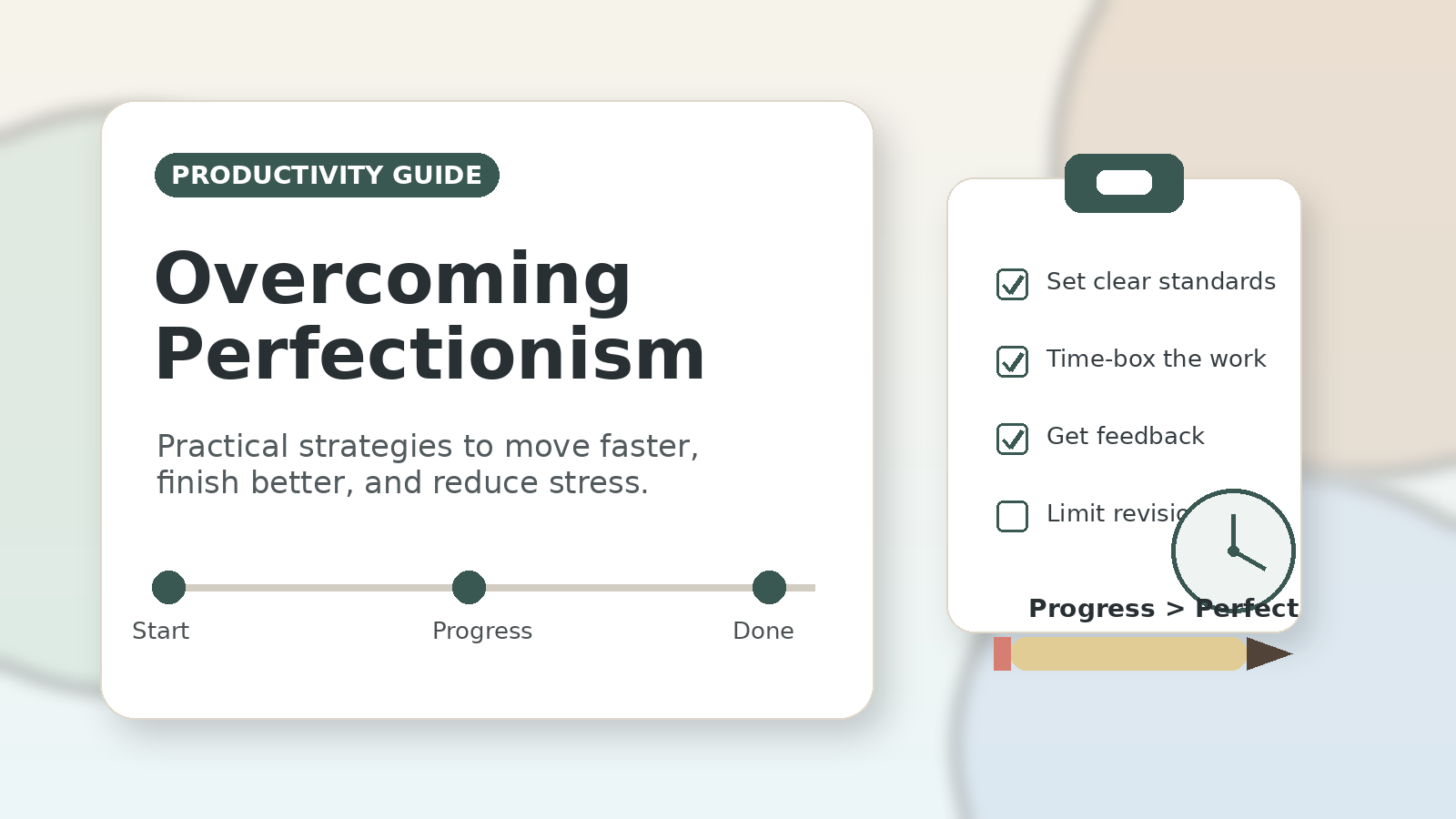
Perfectionism can feel like a high standard that pushes you forward — until it becomes a roadblock. When every task feels like it requires flawless execution, progress slows, decisions stall, and stress rises. The good news: you can keep high standards without letting perfectionism destroy your productivity. This post gives clear, actionable strategies to break perfectionist habits, boost efficiency, and get more meaningful work done with less stress.
What perfectionism looks like (so you can spot it)
- You delay starting projects because you want the “perfect” plan.
- You over-edit and spend excessive time polishing small details.
- You avoid tasks where failure is possible, or you say “yes” to everything to control outcomes.
- You obsess over worst-case scenarios and repeatedly revise work beyond value.
Recognizing these patterns helps you choose the right strategy to change them.
Shift your mindset: good-enough vs. perfect
- Set outcome-focused standards. Decide what success looks like for each task in measurable terms: “publish with 80% of features working” vs. “perfect product.”
- Reframe mistakes as learning. Treat errors as feedback rather than proof of inadequacy. This reduces fear and frees you to act.
- Use time-limited experiments. Commit to trying something imperfect for a short period (e.g., a one-week prototype) to gather real data before refining.
These mindset shifts reduce the paralysis that perfectionism causes and encourage iteration over stagnation.
Plan for progress: break tasks into manageable steps
- Use micro-tasks. Break large projects into 15–60 minute tasks you can complete in one sitting. Completing small items builds momentum.
- Prioritize by impact, not by perfectability. Focus first on tasks that move outcomes forward (client deliverables, launch-critical work) rather than on cosmetic improvements.
- Apply the 80/20 rule. Identify the 20% of work that delivers 80% of the result and tackle that first.
Small, prioritized steps accelerate forward motion and keep perfectionist impulses in check.
Set practical time limits and guardrails
- Time-box work sessions. Work in fixed blocks (e.g., Pomodoro: 25–50 minutes with short breaks). When the timer ends, stop and assess progress.
- Create “finish” rules. Decide beforehand what counts as “done” for a task (deliverable quality, required checks). When those rules are met, stop refining.
- Use deadlines as positive constraints. Deadlines focus attention and reduce endless tweaking. Prefer realistic but slightly tight deadlines to fight over-polishing.
Time constraints create healthy pressure and force decisions rather than endless tweaking.
Develop iteration and feedback loops
- Prototype quickly. Build minimal viable versions (drafts, mock-ups) to test ideas before perfecting them. Real-world feedback beats guesswork.
- Seek targeted feedback. Ask specific questions: “Is this idea clear?” or “Which part is confusing?” General requests invite vague criticism that fuels doubt.
- Schedule short review cycles. Regular, quick reviews (daily or weekly) allow steady improvement without massive rework.
Iterative work reduces wasteful perfectionism by making improvements based on evidence, not assumption.
Adopt effective productivity systems
- Use to-do lists with clear priorities. Keep a weekly master list and daily top-3 tasks. Completing top priorities protects progress.
- Batch similar tasks. Group similar activities (email, editing, calls) to reduce context switching and decision fatigue.
- Automate and delegate. Remove repetitive tasks through tools or hand them to others when possible. Perfectionists often try to control everything; delegation frees time for higher-impact work.
Systems reduce friction and stop perfectionism from choking productivity.
Practice decision-making frameworks
- Use the “two-minute rule.” If it takes less than two minutes, do it now. This prevents small items from piling up into big mental clutter.
- Apply a decision threshold: OK vs. Excellent. For lower-impact tasks, choose “OK” and move on; reserve “Excellent” for top-priority work.
- Use time-based decisions. Spend a fixed amount of time deciding, then commit. Overthinking decisions is a common perfectionist trap.
Clear rules make decisions faster and reduce the need for endless refinement.
Control your environment to reduce friction
- Minimize distractions. Remove notifications, tidy your workspace, and prepare what you need before starting a focused session.
- Create a “start” ritual. A simple routine (making coffee, opening a project template) signals your brain it’s time to work and reduces initial resistance.
- Designate finishing cues. End-of-session rituals (saving files, noting next steps) help you stop working without obsessing over small changes.
An environment tuned for focus limits the small interruptions that perfectionists magnify.
Manage emotions and self-talk
- Name the fear. Are you afraid of criticism, rejection, or making a mistake? Naming the fear reduces its power and clarifies what you can do about it.
- Replace “must” with “choose.” Swap statements like “I must do this perfectly” with “I choose to do this well enough to achieve X.” This subtle language shift reduces pressure.
- Practice self-compassion. Treat yourself as you would a teammate; being kind lowers anxiety and improves learning.
Managing emotions directly reduces the internal drivers of perfectionism and allows steadier work.
Use measurable goals and metrics
- Define specific, measurable goals. Instead of “write a post,” aim for “write 1,200 words by 3 PM.” Concrete targets make progress visible.
- Track progress with simple metrics. Time spent, tasks completed, conversion rate improvements — choose metrics that matter and celebrate gains.
- Review results, not intent. Evaluate based on outcomes (did it achieve the goal?) rather than how perfect it felt during the process.
Objective measures shift the focus from subjective perfection to real-world impact.
Limit revision cycles
- Cap the number of revisions. Decide, for example, three rounds of edits maximum. Each round should address clearly defined issues.
- Use versioning. Save milestone versions (v1, v2) and treat each as an opportunity to iterate rather than an incomplete final.
- End with a confidence check. Ask, “Would this meet the minimum standard if a client saw it now?” If yes, publish.
Capping revisions prevents endless tinkering and encourages completion.
Build habits that reduce perfectionist impulses
- Routine over inspiration. Establish regular work times so you rely less on feeling “inspired” and more on consistent action.
- Start before you feel ready. Force small initial actions (open file, write the first sentence) to break the perfectionist stall.
- Reward progress, not perfection. Celebrate finished items and incremental wins to reinforce productive behavior.
Habits make it easier to act despite perfectionist doubts.
Practical exercises to rewire behavior
- The 80% challenge: Deliver work at 80% quality and track results. Notice how much improvement actually matters when you get real feedback.
- The 1-hour prototype: Build a quick version of a project in one hour. Use it to test assumptions and gather data.
- Public accountability: Share a simple promise (tweet, team message) with a deadline. Public commitment increases follow-through.
These exercises build tolerance for imperfection and show you the payoff of moving faster.
When to aim for excellence instead of “good enough”
- High stakes or safety-critical tasks need near-perfection. Identify the few tasks where higher investment is justified.
- When you’re building a long-term reputation or a signature product, invest more time but still use staged improvement and feedback.
- Use selective perfection: aim for excellence on the small number of things that truly matter; accept “good enough” elsewhere.
This selective approach balances quality and efficiency without abandoning standards.
Technology and tools that help
- Task managers: Asana, Todoist, Notion for prioritization and progress tracking.
- Time tools: Pomodoro timers, Focus apps (Forest, Focus@Will) to enforce time-boxing.
- Collaboration tools: Shared docs and comment threads for targeted feedback and version control.
- Automation: Templates, macros, and workflow automations to remove repetitive perfectionist busywork.
Tools are only helpful if you use them with clear rules—avoid turning tools into new perfection traps.
Dealing with setbacks and slip-ups
- Expect backsliding. Perfectionist habits are persistent; treat setbacks as normal and refocus quickly.
- Analyze, don’t ruminate. When you stall, list the real obstacles and choose one small action to move forward.
- Recommit to rules. Reset time limits, finish rules, or revision caps when you notice slippage.
A forgiving, pragmatic recovery process keeps momentum even when perfectionist tendencies return.
Practical weekly routine to increase efficiency
- Monday: Set weekly outcomes and top 3 priorities. Time-box planning to 30–45 minutes.
- Daily: Start with the top-priority micro-task for 60–90 minutes. Use Pomodoro sessions for focus.
- Mid-week: Prototype or collect feedback on progress. Limit revisions to scheduled review slots.
- Friday: Review metrics, decide what needs improvement, and archive the week’s “done” items. Celebrate progress.
A short, consistent routine makes finishing tasks normal and reduces perfectionist stalls.
Quick checklist to use before deciding “not done”
- Does this meet the predefined success criteria? If yes, publish or move on.
- Will further refinement change the outcome materially? If no, stop.
- Is this work on a high-impact item that warrants more time? If no, accept “good enough.”
- Have I asked for targeted feedback? If not, get feedback and revisit only if necessary.
Use this checklist as a final gate to prevent endless tweaking.
Conclusion: act imperfectly, learn quickly, improve meaningfully
Perfectionism steals time and momentum. The antidote is practical: set clear standards, time-box work, break tasks into tiny steps, get evidence through prototypes, and limit revisions. Combine mindset shifts with concrete systems—prioritization, time limits, and feedback loops—to move faster and smarter. Over time, incremental changes add up: you’ll produce higher-quality work with less stress and more impact.